Showing posts sorted by relevance for query #BiennaleArchitettura2023 - 18th International Architectural Exhibition central pavilion. Sort by date Show all posts

Monday, May 29, 2023

#BiennaleArchitettura2023 - 18th International Architectural Exhibition - Central Pavilion - Giardini


"Architects have a unique opportunity to put forward ambitious and creative ideas that help us imagine a more equitable and optimistic future in common”.
Lesley Lokko
curator

#BiennaleArchitettura2023 - 18th International Architectural Exhibition
Central Pavilion -  The Laboratory of the Future
Giardini

The Biennale Architettura 2023 - until November 26 - entitled The Laboratory of the Future is curated by academic, educator and novelist Lesley Lokko and chaired by La Biennale di Venezia president, Roberto Cicutto.  The exhibition is organised in six parts and includes 89 participants, over half of whom are from Africa or the African Diaspora and for the first time ever, nearly half of participants are from sole or individual practices of five people or less.


“Central to all the projects is the primacy and potency of one tool: the imaginationIt is impossible to build a better world if one cannot first imagine it. Threaded through and amongst the works in both venues are young African and Diasporan practitionerswhose work engages directly with the twin themes of this exhibition, decolonisation and decarbonisation, providing a snapshot, a glimpse of future practices and ways of seeing and being in the world. (…) We have deliberately chosen to frame participants as ‘practitioners’ – and not ‘architects’ and/or ‘urbanists’, ‘designers’, ‘landscape architects’, ‘engineers’ or ‘academics’ because it is our contention that the rich, complex conditions of both Africa and a rapidly hybridising world call for a different and broader understanding of the term ‘architect’."
Lesley Lokko - curator


ACE/AAP
Olalekan Jeyifous

In the wake of the Pan-African movement and African decolonization, imperialist infrastructures devoted to economic exploitation and resource extraction are rapidly dismantled, while local environmental groups throughout the continent consolidate into what is known as the African Conservation Effort (ACE).
Barotse Floodplain’s AAP imaginary lounge is ACE/AAP


To repair the damage done to the African continent’s ecoregions by former colonial powers, the African Conservation Effort (ACE) applied Indigenous knowledge systems to developing advanced networks that synthesised renewable energy and green technologies. Chief amongst these was the All-Africa Protoport (AAP).


AAP is now a network of sprawling low-impact, zero-emissions travel complexes situated off the coasts of major ports throughout the world. Until recently, there were twelve AAPs located in the following cities: Lagos, Mombasa, Port Said, Dar es Salaam, Durban, Salvador de Bahia, New York, Los Angeles, Port-Au- Prince, Barranquilla, Havana, and Montego Bay. A new AAP complex completed in 1972, unlike its coastal counterparts, is embedded somewhat controversially in the Barotse Floodplain in Zambia’s Western Province. The Barotse Floodplain’s AAP imaginary lounge is ACE/AAP presented in The Laboratory of the Future.

photo - Andrea Avezzu - courtesy - La biennale di Venezia

Silver Lion Award
Promising Young Participant

Olalekan Jeyifous, won the Silver Lion Award for the multimedia installation that explores a worldbuilding practice that expands public perspectives and imaginations, offering visions of a decolonized and decarbonized future.


Counteract
Kere Architecture Diebedo Francis Kere 

The entire continent of Africa is responsible for less than 4% of the world’s greenhouse gas emissions. This startling fact gives pause. A moment in which to look and feel. To consciously create goals in line with needs determined from within. To find modes of building that do not replicate loss but rebuild ancient knowledge. To find knowledge that is not worthless but rather constitutes an invaluable wisdom that can fuel hope. To do just that, Counteract celebrates West African architectural prowess of the past, takes stock of today’s situation and nudges us towards a different approach. It is a viable and fantastic vision of architecture. 


Kere Architecture considers materials and skills required to build buildings that are not too hot or cramped, dwellings that existed in a time before the current status quo. Kere Architecture re-centres the value of this embedded knowledge, proposing it as a ‘counteract’ to the chase for modern architecture.


Native(s) Lifeways
Hood Design Studio
Walter Hood - Alma Du Solier 
Michael DeGregorio - Paul Peters 

As shown in the exhibition we propose a new Arts Lifeway in the creek of PhillipsSouth Carolina, enmeshed with grasses and reeds. Basketmaking pavilions evince their logic of production and ornamentation along a sweetgrass walk connecting the communal landscape.  Large rice-toting baskets that men used to harvest inspired the columns, while the ornamental basketmaking of children and women influenced the roof and awnings.  Constructed of renewable wood harvested from the overgrown, the houses and walkway speak to a continued occupation of native landscape.
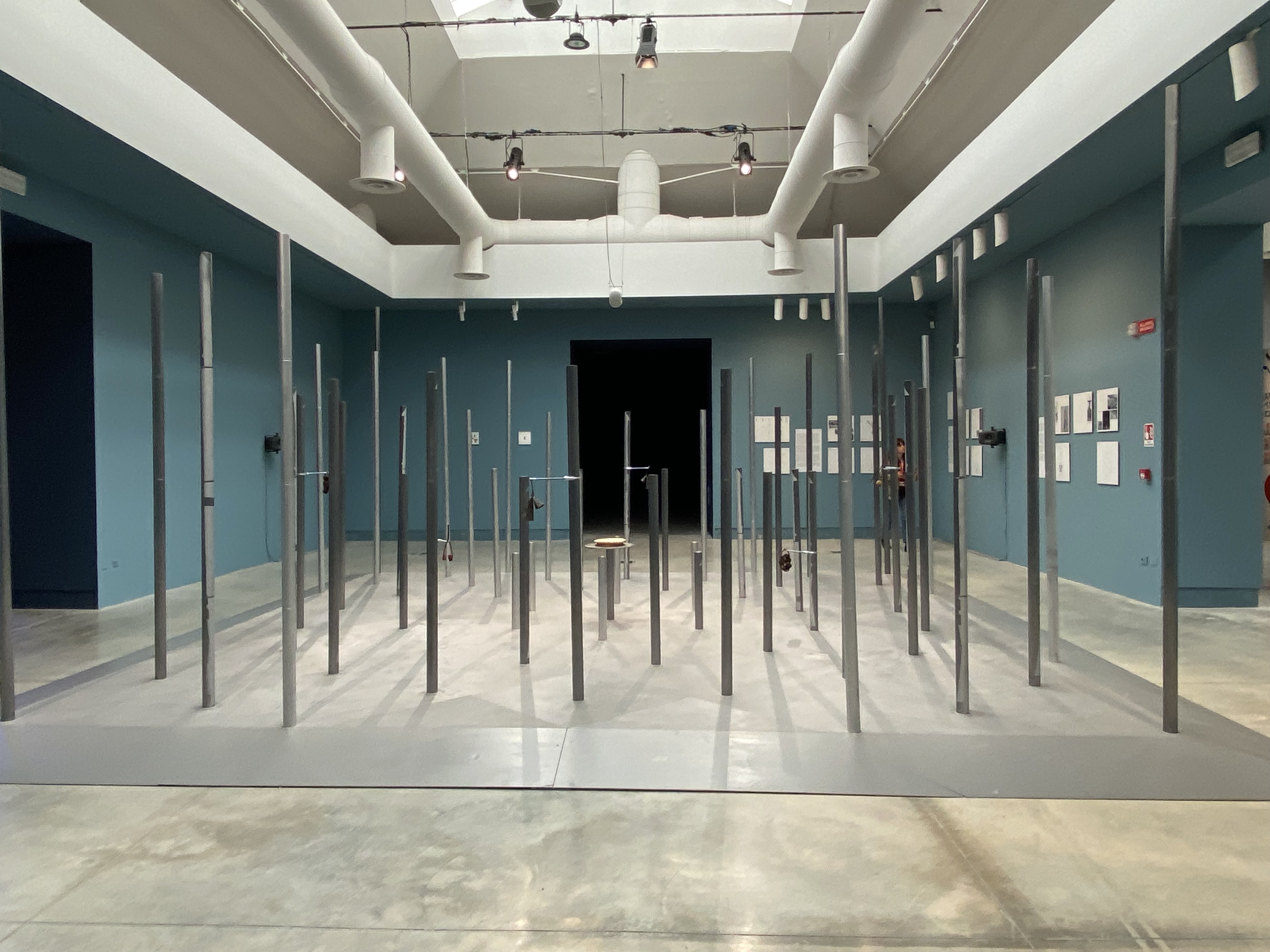

The African Post Office
Sumayya Vally - Moad Musbahi

As a space for sorting and processing, the African Post Office brings together different ‘posts’ from across the continent and the larger lagoon of Venice. The project develops an intercontinental bureaucratic apparatus using the simple technology of the post. It operates in two dimensions: as a spatial reinterpretation of the post as a pole, and as the infrastructural mechanism of a postal network that considers routes of prior passage.


Experienced both visually and aurally, a language and related index of the ‘post’ is developed, building on the logic of minarets and totems, two sociocultural technologies with far-reaching
African influence. The field of posts of various thicknesses and heights have individual markings and attachments. Some hold flags of nations that no longer exist, and others are simply attachment points waiting to be moored.
Moad Musbahi and Sumayya Vally


Land Narratives - Fantastic Futures
Urban American City (UrbanAC) - Toni L. Griffin 

There is an undeniably dystopic past at the core of every African American’s history. However, this narrative is not exclusively situated in pain. Within every Black space and body that holds this trauma, there exists an element of the fantastic that breeds resilience and creativity. Between the milestones of Juneteenth and the Civil Rights Movement, Blacks in Northern America migrated to segregated cities and built prosperous economies, producing extraordinary Black wealth, technologies, and culture. However, as Sylvia Wynter describes, our value has always been “measur[ed]… according to the single yardstick of technoscientific accomplishment that is defining the contemporary West’s [and White] ‘mechanical perfection’.”


Land Narratives — Fantastic Futures
 exposes the lost histories and unrecognised imaginations of creativity born in spite of the segregation and land vacancy found in ‘Black Belt’ neighbourhoods of Chicago’s South Side. It develops new, multiple, and wayward ‘yardsticks’ for identifying and working with previously unmeasured cultural values.
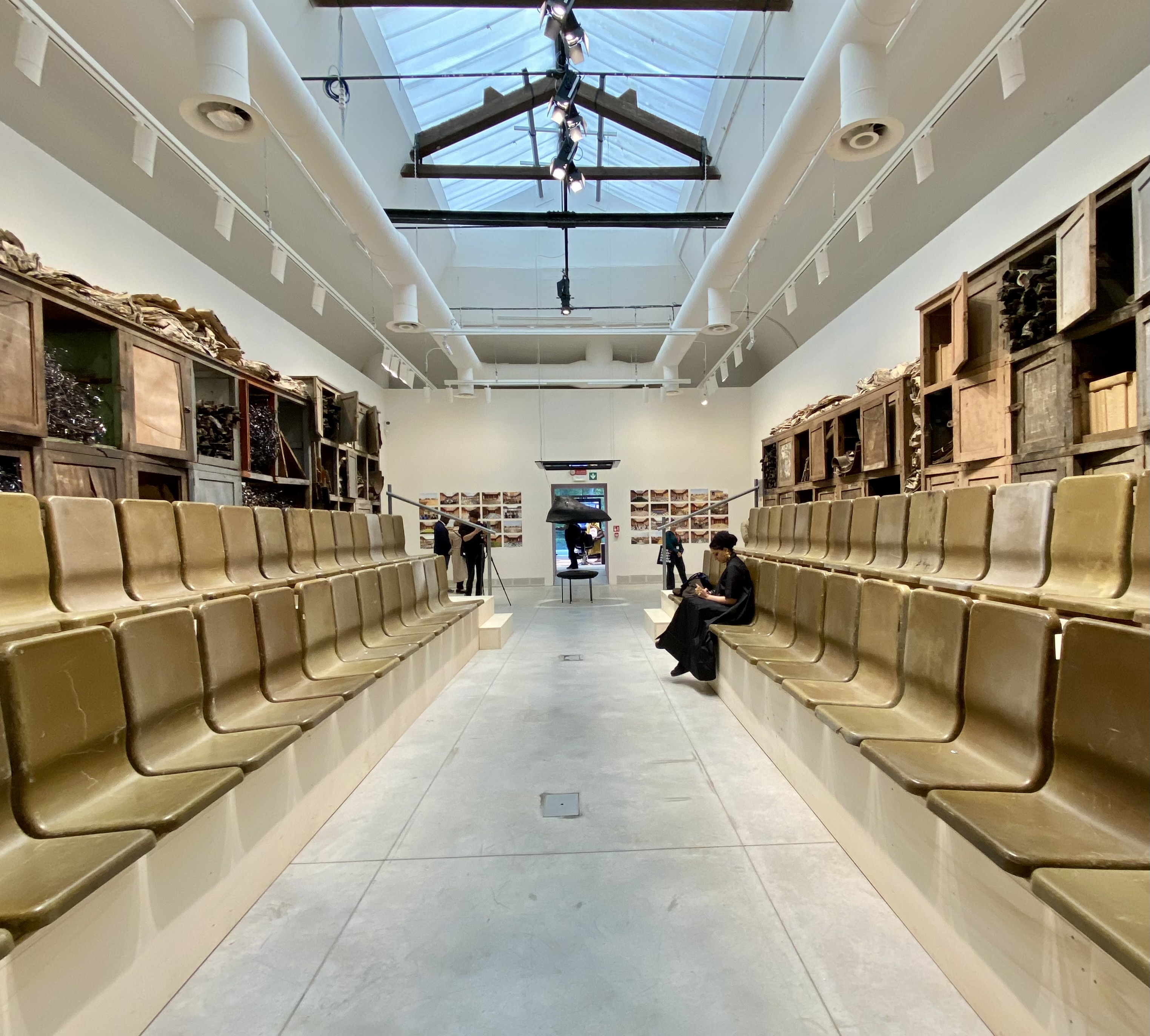

Parliament Of Ghosts
Ibrahim Mahama

Parliament of Ghosts was conceived for The Whitworth art gallery in Manchester as part of the Manchester International Festival in 2019. The work originally addressed historical ideas around materials and issues of colonial exploitation, but it was subsequently transformed into the architecture of Red Clay in Tamale, Ghana. The set-up allows objects and ecosystems to coexist with architectural form, from a conceptual, philosophical, and physical point of view. Memories are excavated through the placement of non-human forms while young audiences are encouraged to acquire new perspectives on their relationship to architecture. 


The space was inspired by both the residue of the Gold Coast Railway infrastructure and abandoned modernist buildings from the 1960s Nkrumah’s Voli-ni in TamaleIn The Laboratory of the Future, a series of questions are posed. How do we restore memories to which access was denied? How do we excavate the past in order to build new futures?


Ibrahim Mahama and Lesley Lokko


Textural Threshold Hair Salon: Dreadlock
Softlab @ PSU Felecia Davis 

Forming a space between two words, ‘dreadlock’ is a word of uncertain etymology. For English speakers, this is clearly a portmanteau, two words making one. Dread, fear, anxiety about the future, but also awe or reverence. And the word ‘loc’, Germanic in origin, which refers to a curl or strand of a person’s hair that curls together, or the property of matted hair, tangled beyond untangling, knotted forever.


This installation roves from knowledge and language that the weaving hand knows into computational and digital knowledge systems. There are experiments with locking techniques related to felting in textile practice and digital combing/sorting to make a hybrid threshold. The digital threshold space in the installation uses machine learning trained on a designed database of global hair textures. The physical threshold is a knitted isacord passage made of felted dreadlocked material.


Djali
Basis with GKZ - Kibwe Tavares - Zenna tavares

This work is a narrative exploration into counterfactual pasts and hypothetical futures, fusing the mediums of film, sound, and computation to transport audiences beyond the constraints of the present. Djali explores storytelling and visualisation of hypothetical worlds, narrated from the perspective of an artificial intelligence present in them. Experientially, Djali is interactive, building on advances in natural language processing, computer vision, and computation to simulate our human ability to mentally explore possible and even impossible worlds with our mind’s eye.


Zenna Tavares and Gaika Tavares
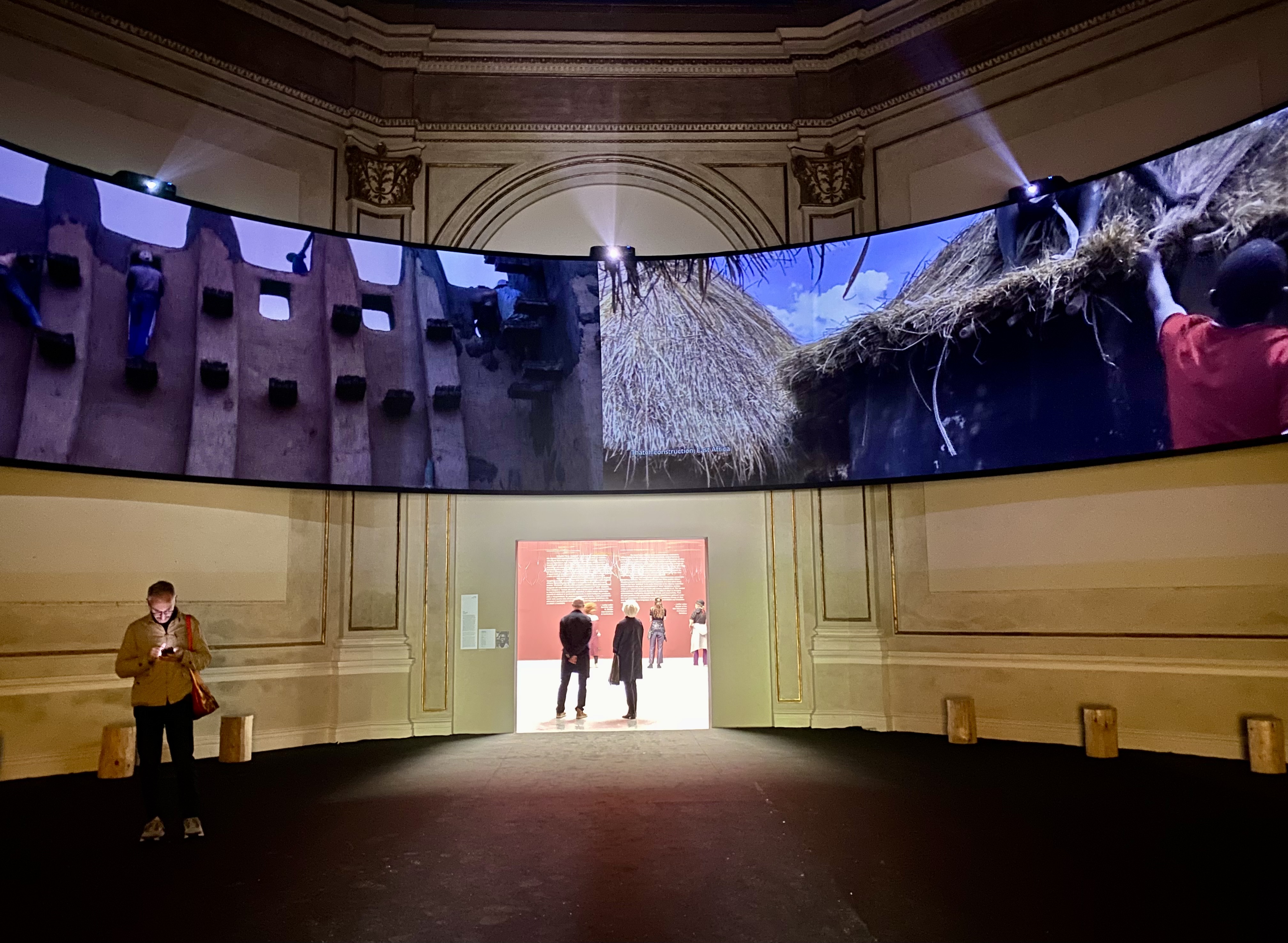

Adjaye Future Labs
Adjaye Associates Sir David Adjaye OBE 

The Adjaye Futures Lab features a field of physical models paired with narrative films. The selected projects showcase narratives that emerged outside of the dominant canon, such as the Thabo Mbeki Presidential Library and its precolonial inspiration, and the Edo Museum of West African Art/Creative District, which aims to reconstruct, resurrect, and reposition ancient Benin City as a powerhouse of cultural output. These are narratives that speak to an ongoing quest to define, amplify, and encourage diasporic connection and cultural production, expressed through the Newton Enslaved Burial Grounds and Museum project and the Africa Institute in Sharjah.
Collectively, the selected projects speak to notions of placemaking, identity, memory, and meaning as central to the design process with the ambition to create structures conducive to positive forms of human transformation.
 

Pin It

Tuesday, August 08, 2023

#BiennaleArchitettura2023 - 18th International Architectural Exhibition - The Laboratory of the Future - Arsenale


#BiennaleArchitettura2023 - 18th International Architectural Exhibition
The Laboratory of the Future
Arsenale 
The Biennale Architettura 2023 - until November 26 - entitled The Laboratory of the Future is curated by academic, educator and novelist Lesley Lokko and chaired by La Biennale di Venezia president, Roberto Cicutto.   Central to all the projects is the primacy and potency of one tool: the imagination. It is impossible to build a better world if one cannot first imagine it. The Laboratory of the Future begins in the Central Pavilion in the Giardini and then moves to the Arsenale. Threaded through and amongst the works in both venues are young African and Diasporan practitioners, the Guests from the Future's, work engages directly with the twin themes of this exhibition, decolonisation and decarbonisation, providing a snapshot, a glimpse of future practices and ways of seeing and being in the world. In the Arsenale complex, the 37 practitioners chosen all work in hybrid ways, across disciplinary boundaries, across geographies, and across new forms of partnership and collaboration.


Those With Walls for Windows
Rhael 'LionHeart' Cape
Those With Walls for Windows is a meditation and exploration into the - laws of freedom. Through poetry, an art form with its own relationship to freedom and control, the work investigates the space of diaspora, a place where forgetting, remembering, and reimagining act as architectural devices in the urban planning of the diasporic psyche. It is an aural–visual–textual–oral tapestry that uses performance, rhythm and erasure as structuring devices, a - call to arms - for sonic way finders who seek Carnival’s joyous, redemptive liberation.


Griot
Studio Barnes - Germane Barnes 
Studio Barnes presents Griot, which speculates on the legacies that are hidden in our foundational architectural canon. A Griot, historically, is a West African storyteller. In this installation, built objects supply narratives of architecture, identity, colonisation, and the cultural influences of the African Diaspora.  Using the exhibition as the point of departure, the Griot oscillates between text and word. Much of the research and writings that document this missing architectural history is found outside of the discipline. Rather than architecture, it is archaeology and anthropology that contain a plethora of knowledge on procedures, production, and people. The disciplinary combinations of architecture, archaeology, anthropology, and identity reflect a new, hybrid architecture that moves fluidly between borders and boundaries, a new architecture of The Laboratory of the Future.


Time and Chance 
Studio Of Serge Attukwei Clottey  
Serge Attukwei Clottey
For The Laboratory of the Future, Clottey has constructed an iteration of his - Afrogallonism - project, installed along the upper support structure of the Gaggiandre - above. The work hangs organically, its shape defined by its own weight, suspended above the water, the reflection catching along the surface below. In the Corderie - below - hangs a fragment of this work.  Clottey works across installation, performance, photography, painting, and sculpture, exploring personal and political narratives rooted in histories of trade and migration. Based in Accra, Ghana, Clottey refers to his work that uses primarily plastic, yellow, Kufuor-era gallon containers as ‘Afrogallonism’, a concept that confronts global material culture through the cutting, drilling, stitching, and melting of these found materials. 


Time and Chance  - Studio Of Serge Attukwei Clottey  


Pilbara Interregnum: Seven Political Allegories
Grandeza Studio
Amania Sanchez-Velasco - Jorge Valiente Oriol - Gonzalo Valiente Oriol
The Pilbara is an immense, arid, and thinly populated territorial crust in the north of Western Australia. Since the first colonial incursions, just 160 years ago, the progressive ‘discovery’ of its rich mineral deposits has transformed the region into a spatiotemporal battlefield of expulsions, explosions, and exploitation, papered over by the colonial ‘development’ myth. In fact, despite its label as ‘the powerhouse of the nation’, the Pilbara still suffers from significant infrastructural underdevelopment and high rates of racialised social exclusion.   The work takes the opportunity offered by the current energetic paradigm shift to put in crisis the extractivist, colonial, and capitalist mythologies that are turning this region, and the rest of the planet, into sacrificed areas. A constellation of seven political allegories re-stage the Pilbara by moving it away from a resources-extraction battlefield into an epistemological war of political imagination.


Surfacing — The Civilised Agroecological Forests of Amazonia
Estudio A0
Ana Maria Duran Calisto - Jaskran Kalirai
Gold prospecting using LiDAR in the twenty-first century has brought to the surface not only vast mineral deposits but also evidence of mega-regional cities. The digital whispers of these cities forcefully speak of the civilisations built by the people of the Amazon River basin tributaries for over five millennia. The civilisations of oral traditions are wanting of recognition, not as exotic urbanisms to be marginally included in history textbooks, but as brilliant, working examples of urban ecology that may lead our way into a reconciliation of the city, its foods systems, and its hinterlands. This is the focus of this exhibition.


Surfacing — The Civilised Agroecological Forests of Amazonia - Estudio A0


Debris of History- Matters of Memory
Gloria Cabral - Sammy Baloji with Cecil Fromont
Toxic landscape, social scars, and the history of global capitalism bridge Brumadinho in Brazil and Katanga in the Democratic Republic of the Congo. These two parts of the world are central to, respectively, Gloria Cabral’s architectural practice reusing demolition and Sammy Baloji’s visual art interrogating central Africa’s colonial heritage.  Together, they create a transmedial structure in which construction debris and bricks made of mining waste from Congo’s former metropolis – Brussels - Belgium – form ornamental patterns echoing the architectural textiles of the historical Kongo kingdom, as well as their Brazilian Indigenous cognatesTheorised in conversation with art historian Cecile Fromont from a common interest in the Tenture des Indes of the Villa Medici in Rome, the project weaves a tapestry of bricks. The wall and its motifs highlight the value of debris and the potential of patterns to form architectural, historical, and social structures for a reimagined future.


It's Kind of a Circular Story
AMAA Collaborative Architecture Office for Research and Development
Marcello Galiotto - Alessandra Rampazzo 
Decarbonisation is a challenge that today faces every architect. AMAA explores this challenge by comprehensively considering the reuse of the ex-NATO base of Monte Calvarina, between Vicenza and Verona in Italy. The military base, active from 1959 to 1995, hosted a missile unit of the Italian Air ForceDecades after its abandonment, the complex today finds new social and operational use. The years of decay are substituted by a lively and disruptive facility, set up by Fondazione SAFE - Security and Freedom for Europe - as a hub to organise training and simulations for emergency response and testing of innovative technologies. Calvarina will be an open workshop where innovation and natural preservation coexist; a kind of ‘laboratory of the future’, but in the present. In the Arsenale, AMAA presents fragments of their ongoing work to face the social, spatial and material past and future of Monte Calvarina.


Alessandra Rampazzo, Yehuda Safran and Marcello Galiotto 


Emotional Heritage
Flores and Prats Architects
Ricardo Flores - Eva Prats
It is not only people who contain the memory of a place: buildings too are loaded with memories of the uses and lives that occupy them. The built fabric reflects social behaviour. It speaks of a way of using the ground, the sky, and of a way of inhabiting. As an architect, to read the memories held in buildings and people is to think about a future that depends on that past.To open the discussion around these thoughts Flores and Prats have brought process material to Venice, unfinished drawings and models, documents that incorporate doubts and reflections, lying on tables to encourage exchange. These documents, organised as a kind of workshop, will be the beginning of a conversation, objects between people and subjects such as - The Unfinished Condition of the RuinThe Right to InheritDrawing With Time, and The Value of Use.

Ricardo Flores, Eva Prats with Laia Montserrat


Emotional Heritage - Flores and Prats Architects


Regenerative Power
Gbolade Design Studio
Tara Gbolade - Lanre Gbolade
In 1948, the HMT Empire Windrush docked in Tilbury, bringing workers from the West Indies to help fill post-war UK labour shortages. Dubbed the - Windrush Generation - the community faced intolerance and was denied access to public services and accommodation.This exhibition focuses on a new building and the social and cultural ecosystems of the users of the Lloyd Leon Community Centre ecosystems that renew and empower the West Indian community in Brixton, London, and far beyond. It is a celebration of the rich and diverse history of the British West Indian community. It explores the way the centre serves some of the most vulnerable in society, from the elderly who have a place to reminisce and stave off loneliness to those who need to get back on their feet with food and work in this tightknit community.


Lanre Gbolade and Tara Gbolade


Enviromolecular
Low Design Office
Ryan Bollom - DK Osseo-Asare
Integrating design and engineering, the work of Low Design Office advances a model of autoconstruction that recasts kiosk culture as an emergent infrastructure for African - rurban’ transformation. Launched with French design consultancy Panurban in 2012, the Agbogbloshie Makerspace Platform - AMP - initiative combines lab research and iterative ‘popular prototyping’ via community workshops with grassroots makers in West Africa to co-design flexible archi-technology for crafting space. Coproduced in and around Accra’s Agbogbloshie scrapyard, recycling, and maker hub, AMP amplifies circular processes of (re)making with others as a mode of collective habitation. 


A Voice for the 450 Plus
Black Females in Architecture
Akua Danso - Selasi Setufe - Neba Sere - Ama Onfori-Darko
Women make up 49.58% of the world’s population and groups labelled ‘minorities’ are actually the global majority. So-called ‘minority’ women are massively underrepresented in most professional fields and industries, and architecture is no exception. The authors of our built environments are largely unreflective of the populations they serve. Black Females in Architecture - BFA - is a social enterprise supporting a membership of more than 450 Black women in built environment professions worldwide. The group advocates for diversity and race and gender equity across all sectors of the built environment, including architecture, urbanism, landscape, engineering, design, and construction. This film is a celebration of the ongoing contributions of Black women in the built environment fields, showing the world how they contribute to shaping the future of our cities.


Co-Living Courtyard
ZAO/standardarchitecture
Zhang Ke
The installation, conceived as a co-living workshop, invites visitors to reflect on the work of ZAO/ standardarchitecture under a suspended mock-up of the Hangzhou Museum, ponder in its courtyard as the philosophers did in ancient Chinese gardens, and dwell on the vital relationships between interior and exterior, architecture and landscape, memory and identity, envisioning new aspects of co-living and inducing discussions on sustainable co-living.


Co-Living Courtyard - ZAO/standardarchitecture


Dualchas
Dualchas Architects
Neil Stephen - Alasdair Stephen - Rory Flyn
In the Hebrides and on the mainland of Scotland, Dualchas live and work in a landscape that is sometimes harsh, sometimes peaceful, but always inspiring. They make buildings on the edges of lochs, in quiet glens, amongst woods, and on rock. These buildings have a direct connection to beaches, the sea, and mountains.  In The Laboratory of the Future, Dualchas Architects tells a story of people, place, and culture, through their collaboration with a film director, sound artist, and writer. The film describes the environment they work in, its climate, geography, and topography, using language, music, and field recordings. The broader story of decolonisation can be understood through personal experience, through families who have a deep connection to this place and a desire to return to work and live here and to create an architecture that is appropriate to both its time and place.


Threads
Kate Otten Architects
The golden thread of Johannesburg’s history started some two billion years ago when a massive meteorite crashed into the earth approximately one hundred kilometres south of the city. Gold deposits were buried in seams deep below the surface, coming to rest in an arc-shaped ridge. The discovery of gold in 1886, and the gold rush that followed, led to the establishment of Johannesburg.  Unlike a linear, patriarchal recording, this story is presented in The Laboratory of the Future as a simultaneous, intuitive reading of landscape narrated by women through craft and making.  Materials used are natural, decomposable, and specific to South Africa. The makers are women’s collectives, crafts, age-old traditions. The play of light and shadow, the use of colour and pattern, and the hand-making and collaborative process all represent our approach to architecture that is particular to a place and nurtures the human spirit.


Ghebbi
AD-WO
Emanuel Admassu - Jen Wood
The Amharic word - Ghebbi - connotes a territory surrounded by a wall or fence; a zone of respite and relative stability carved out of an errant and restless city. Slight shifts in enunciation of the word - Ghebbi - produce different meanings: it could mean - come in - the one that infiltrates - or  - income. Ghebbis contain houses, schools, gardens, spaces of worship and commerce. The boundary of the Ghebbi has literal and metaphorical depth. It is not a line on a map, but a zone of contestation pushed and pulled by shifts in politics, culture and economy.


This installation grapples with these instabilities in meaning and effect. Two corrugated panels, are suspended from the rafters, thickening the threshold between two zones of the Arsenale. An immersive space, akin to the lush interiors of the Ghebbi, is recreated by two monumental tapestries suspended on either side of the existing arched opening.


Ghebbi - AD-WO


Pin It