Thursday, June 27, 2024

Venice - Peggy Guggenheim Collection - Jean Cocteau: The Juggler's Revenge


“The lasting feeling that [Cocteau’s] work leaves is one of happiness, 
not, of course, in the sense that it excludes suffering, 
but because, in it, nothing is rejected, 
resented or regretted.” 
W. H. Auden 

Peggy Guggenheim Collection 
Jean Cocteau: The Juggler's Revenge

At the - Peggy Guggenheim Collection  - until September 16 - Jean Cocteau: The Juggler's Revenge - is curated by Kenneth E. Silvereminent Cocteau specialist and New York University art historian.  Brilliant, surprising, and multifaceted, the French artist Jean Cocteau - 1889-1963 - left an enduring mark as a draftsman, filmmaker, set designer, muralist, and jewellery and clothing designer. His poetry, fundamental expression of his unmistakable spirit, is characterised by mythological, circus-like atmospheres and a disorienting writing style that would always accompany his endless creations in the most diverse fields. 
Jean Cocteau in Piazza San Marco - 1956
Cameraphoto Epoche/Getty Images


The exhibition space is also a tribute to the artist’s friendship with Peggy Guggenheim. It was he, actually, who encouraged the young Peggy collector to open the Guggenheim Jeune gallery in London in 1938. She reciprocated by hosting a number of Cocteau’s works, who at the time was a friend and artistic consultant to Marcel Duchamp. Cocteau then began to be a regular visitor to the New York patron’s residence in Venice, Palazzo Vernier dei Leoni, falling in love with the city. Guggenheim often said that words were a means of expression that Cocteau wielded with the virtuosity of an acrobat. The Juggler’s Revenge refers to his ability to move through the most disparate realms with an all-encompassing regard, perspicaciously attuned to aesthetics and history and able to synthesise them.
Jean Cocteau - Untitled Drawing - Peggy Guggenheim's Guest Book - 1956


"To speak to Cocteau, one had to go - to Paris - to his hotel in the rue de Cambon and try to talk to him while he lay in bed, smoking opium. The odor was extremely pleasant, though this seemed a rather odd way of doing our business...He was so beautiful, with his long oriental face and exquisite hands and tapering fingers, that I do not blame him for the delight he took in his image."
Peggy Guggenheim
Out of This century - Memoir

Jacques Lipchitz - Portrait of Jean Cocteau - 1920


PGC's director Karole P.B. Vail and curator Kenneth E. Silver


Jean Cocteau - Gondolier - 1956


The Peggy Guggenheim Collection is an especially fitting venue to host this retrospective exhibition devoted to Jean Cocteau’s artistic career. He had a special love for Venice, a city with which he first fell in love and felt transformed by as a young man and to which he returned regularly for its Film Festival in the years following World War II
Edouard Dermit and Jean Cocteau on a Gondola - 1956c.
unknown photographer


Jean Cocteau, an influential French artist and filmmaker, found deep resonance with the mythological figure of Orpheus, an archetypal poet, musician, and risk-taker. This identification led him to adapt the Orpheus legend multiple times, making it a recurring and central motif in his work. Cocteau's most notable adaptations include a 1926 play and a trio of films: The Blood of a Poet - 1930 - Orpheus - 1950 - and The Testament of Orpheus - 1960. In Cocteau's Orphic productions, the mirror emerges as a pivotal element, symbolizing the boundary between life and death. One of the most famous scenes from Cocteau’s films shows his lover, Jean Marais, portraying Orpheus as he walks through a mirror, now transformed into a liquid portal leading to the underworld. 
Jean Cocteau - Orpheus - film still
Jean Marais traveling through the mirror to the underworld - 1950


Jean Cocteau - The Testament of Orpheus - poster - 1959


Jean Cocteau - Orpheus with Beasts - 1926


Jean Cocteau - Oedipus - or - The Crossing of Three Roads - 1951


Despite the widespread presumption of Cocteau’s homosexuality, he was nevertheless forced to play—in these pre-Stonewall years - a public game of in-and-out-of-the-closet. Refusing to hide his romantic partners or dissociate himself from gay friends - almost - ever pretending to an assumed heterosexuality, often alluding in his work to same-sex interest, Cocteau nonetheless refrained from ever “coming out” in the contemporary sense of the term. Nonetheless, it was by means of the visual, in his drawings, that Cocteau most frankly asserted his sexuality.  He also drew directly on physique magazines - the era’s primary, if coded, form of gay pornography that was largely produced in Southern California toward the middle of the century—making doodles of genitalia and pubic hair on their photographs of scantily clothed models.  
Jean Cocteau - Untitled - 1952
Graphite cover of Ardonis - The Art Magazine of the Male


The ambiguity around Cocteau’s sexuality is perhaps best exemplified by Le Livre Blanc - above - which, because of its homoerotic material, he first chose to publish anonymously and without illustrations in 1928. 
Jean Cocteau - The White Book - 1930


Jean Cocteau - Visit Venice - 1956


Cocteau and Guggenheim reunited throughout the years, he drew a caricature of Guggenheim in a letter and a cityscape in her guestbook - above. While in Venice, Cocteau also made a number of drawings showing the city’s gondoliers and some of its famous buildings like San Giorgio Maggiore
Jean Cocteau - Illustrated Letter - Portrait Of Peggy Guggenheim - 1956c


The Big Names Choose Ribet-Desjardins
Advertisement for Televisions with a Photograph of Jean Cocteau - 1959-1960

Copyright - Adagp/Comite Cocteau - Paris - by SIAE 2024 - courtesy PGC

Having often worked with ballet companies, music groups, and film crews, Cocteau was well-versed in artistic collaboration. As he became increasingly invested in popular culture and mass media, this cooperative spirit flourished. Fashion designer Elsa Schiaparelli was one such creative partner: the eye-shaped earring he made with her - outfitted with a pearl tear -  is indicative of Cocteau’s own approach to jewelry, many of his later pieces showing humanoid or animal-like forms in Surrealist configurations. 
Jean Cocteau - Academician's Sword for Jean Cocteau - 1955

Copyright - Adagp/Comite Cocteau - Paris - by SIAE 2024 - courtesy PGC

Jean Cocteau - Fear Of Giving Wings to Courage - 1938


Jean Cocteau - The Great God Of Pan - Did I Love a dream? - 1958


Pin It

Tuesday, June 04, 2024

New York City - Superhouse - Paa Joe - Celestial City - Exhibition

Photo - Brian Ferry - Courtesy Superhouse

At Superhouse in downtown New York, the exhibition - Celestial City - the exhibition of new sculptures by the international acclaimed Ghanaian artist, Paa Joe.   Throughout a career spanning six decades, Paa Joe has explored Ghanaian beliefs on life and death. His carved wooden coffins, known as abeduu adeka, or proverb boxes, take the form of an object intended to glorify the deceased. Over the past 15 years, Paa Joe has transformed the folk craft tradition into Pop art, creating idiosyncratic renditions of daily objects for the global art market. For his debut solo show in New York, the artist chose to pay homage to the city itself creating a portrait of the Big Apple through objects emblematic of the five boroughs, which included two human sized coffins.
Paa Joe - Installation View  


Superhouse, the New York gallery founded and directed by Stephen Markos, specializes in contemporary and historical art, furniture and design. It stages exhibitions exploring material, technology, function, and narrative, featuring artists from Africa, the Americas, and Europe.
Stephen Markos


Paa Joe - Heinz - coffin - 2024


Paa Joe - container/box - 2024


Photos - Brian Ferry - Courtesy Superhouse

Paa Joe, is a member of the Ga community in Accra, Ghana, he was apprenticed with his uncle Kane Kwei, who pioneered figurative coffins in the 1950s. These bespoke coffins symbolize the deceased's identity, like an onion for a farmer or a sardine for a fisherman. After apprenticing from 1960 to 1972, Paa Joe established his own studio, Paa Joe Coffin Works.
Paa Joe - Yellow Cab - coffin - 2024


On show besides the two human sized coffins, scaled down works, providing a glimpse into the diversity of the urban New York. Replicas of Frank Lloyd Wrights's Guggenheim Museum and a Hermes Birkin bag - above - representing the prominent art and fashion industries. It also features exaggerated versions of a bagel, the Statue of Liberty, and a hotdog, symbolizing New York's migrate history, and the city's grittier side with an overflowing trash can and a subway rat.
Paa Joe - Birkin - container/box - 2024

Photo - Brian Ferry - Courtesy Superhouse

Paa Joe - Big Apple - 2024


Pin It

Wednesday, May 08, 2024

Biennale Arte 2024 - Foreigners Everywhere - Central Pavilion - Giardini


"The expression Foreigners Everywhere has several meanings. First of all, that wherever you go and wherever you are you will always encounter foreigners— they/we are everywhere. Secondly, that no matter where you find yourself, you are always truly, and deep down inside, a foreigner."
Adriano Pedrosa
curator

Biennale Arte 2024 - Foreigners Everywhere 
Central Pavilion - Giardini

The 60th International Art Exhibition, titled Stranieri Ovunque – Foreigners Everywhere - until November 24 - curated by Adriano Pedosa at the Giardini and the Arsenale; is curated by Adriano Pedrosa and organised by La Biennale di VeneziaThe Exhibition takes place in the Central Pavilion - Giardini - and in the Arsenale -  and presents two sections: the Nucleo Contemporaneo and the Nucleo Storico.
MAHKU - Movimento dos Artistas Huni Kuni 
Mural - Facade - Central Pavilion


The title Stranieri Ovunque/Foreigners Everywhere is drawn from a series of works by Paris-born and Palermo-based Claire Fontaine Collective. According to dictionaries, the first meaning of the word “queer” is precisely “strange”, and thus the Exhibition unfolds and focuses on the production of other related subjects: the queer artist, who has moved within different sexualities and genders, often being persecuted or outlawed; the outsider artist, who is located at the margins of the art world, much like the self-taught artist, the folk artist and the artista popularthe indigenous artist, frequently treated as a foreigner in his or her own land. The productions of these four subjects are the interest of this Biennale, constituting the Nucleo Contemporaneo. Whilst the Nucleo Storico gathers works from 20th century Latin America, Africa, the Middle East and Asia.

Adriano Pedrosa - Curator - Brazil 
currently the artistic director of Museu de Arte de São Paulo Assis Chateaubriand – MASP.


Immersed in a counter-artworld of activists and feminists throughout her youth,  Nil Yalter - 
recipients of the Golden Lions for Lifetime Achievement -  has been exhibited and celebrated within major institutions worldwide. The  Nucleo Contemporaneo features two iconic works dealing with the theme of migration. Topak Ev - above - was made in reference to the tents made by Bektik nomadic community in Central Anatolia, traditionally made by brides-to-be and emblematic of gender roles in such communities.
Nil Yalter - Topak Ev - 1973


Exile is a Hard Job is named using the words of Turkish poet Nâzim Hikmet, features videos and fly-posters documenting the lives and experiences of immigrants and exiles, with the work’s title painted over them in bold red letters, in the manner of a political slogan.
Nil Yalter  - Exile is a Hard Job - 1983-2024


Ione Saldanha’s Bambus are a radical way of pushing the boundaries between artistic languages, giving body and liveliness to painting. By appropriating an element from nature, the very organicity of the support claims its sculptural properties. The Bambus invite us to experience colour as we surround them. Hanging from the ceiling, they move subtly, like mobiles, evoking a playful and dynamic feel. 
Ione Saldanha - Bambus - 1960s-70s


Heitor Martins and Fernanda Feitosa


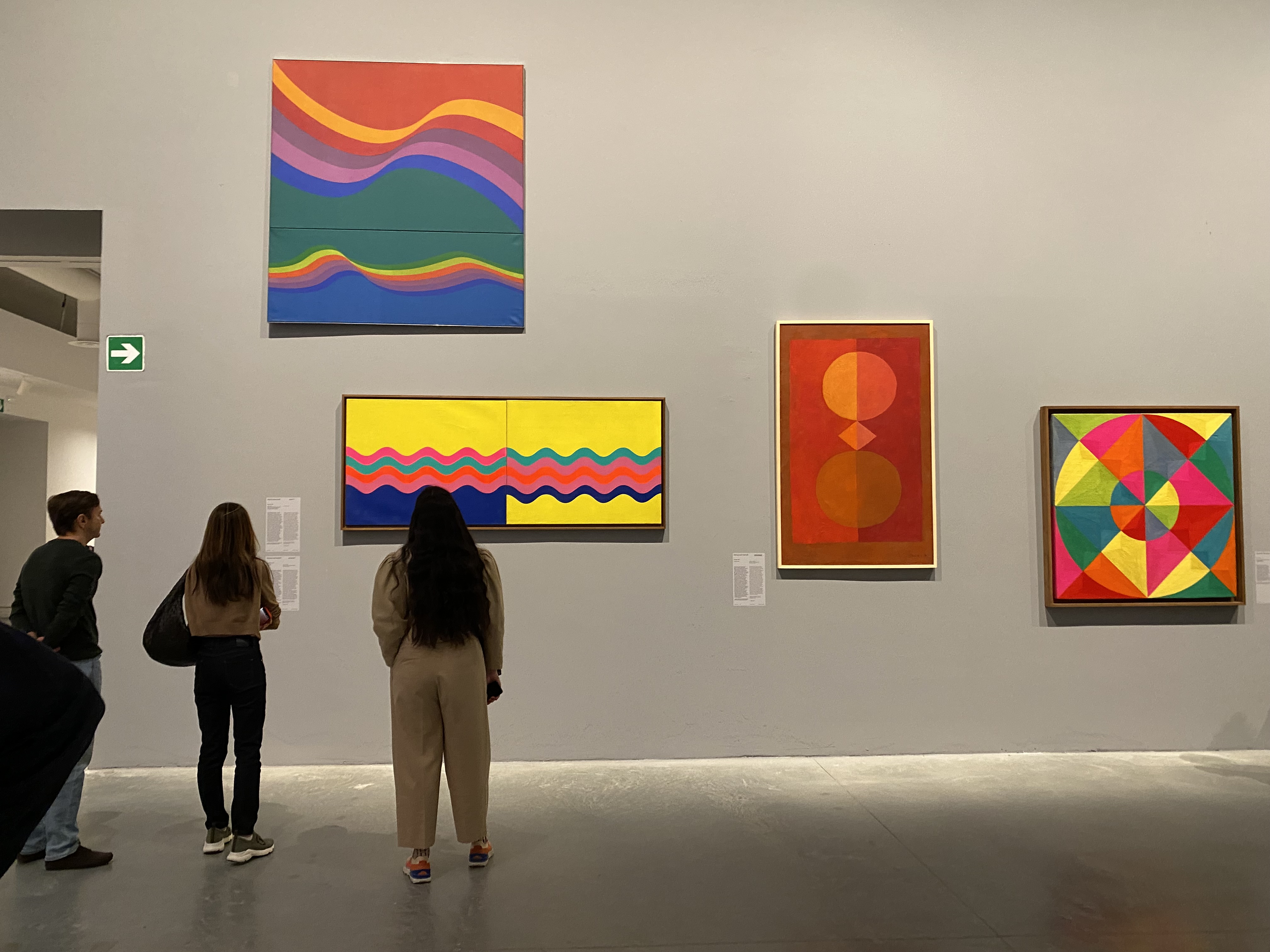
Maria Martorell - Ekho Dos - 1973
Mohamed Melehi - Composition - 1968
Mohamed Hamidi - Harmonie - 1969
Eduardo Terrazas - 1.1.91 - 1970-72


Pablo Delano is a visual artist and photographer with a keen interest in archives and the lives, histories, and struggles of Latin American and Caribbean communities. The installation’s title The Museum of Old Colony - 2024 - ironically references the complicity of museums and a US soft drink brand that is very popular in Puerto Rico, while highlighting how the power and presence of the US is grounded on colonial exploitation, social hygiene, and racial hierarchy in multiple ways, from the circulation of goods, peoples, and values to the recruitment of anthropologists, missionaries, photographers, and politicians in sustaining a colonial matrix.


The Museum of the Old Colony includes myriad objects, photographs, newspapers, films, and magazines from various sources that tell multiple stories related to Spanish and US domination over indigenous and native communities as well as people of African descent, picturing an intricately woven tapestry of Puerto Rico’s troubled histories.
Pablo Delano - The Museum of the Old Colony - 2024


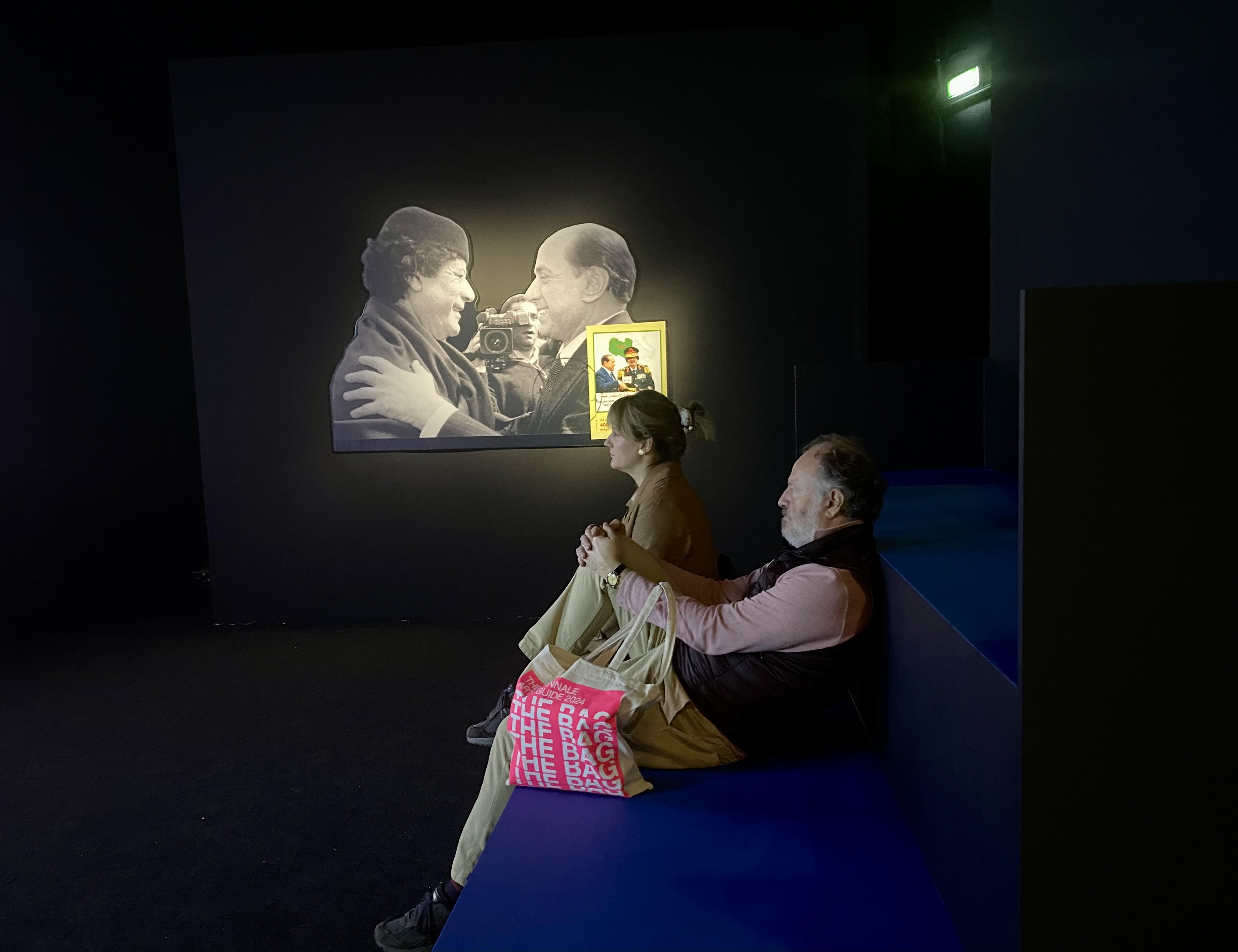
Gaddafi in Rome: Anatomy of a Friendship - 2024 - is part of the research carried out by Alessandra Ferrini since 2017. The title refers to the - treaty of friendship, partnership, and cooperation between Italy and Libya - signed by the then heads of state Muammar Gaddafi and Silvio Berlusconi in 2008. These agreements were ratified during the Libyan leader’s visit to Rome in 2009.  Starting from the iconicity of that encounter, the short film analyses the relationship between the two states, digging into the roots of the Italian occupation between 1911 and 1943 to arrive at the recent bilateral agreements that have redesigned migration policies in the Mediterranean. 
Alessandra Ferrini - Geddafi in Rome: Anatomy of a Friendship - 2024

 
Massimiliano Gioni 
curator - 55th - La Biennale di Venezia - Arte


Omar Mismar - Spring Cleaning - Mosaics Studies - 2022
Teresa Margolles - Human Imprint on Cloth - 2019


Bertina Lopes cultivated a distinctive body of work intimately intertwined with her political activism and social critique. Often blending formal and Constructive elements from European art circles with a visuality associated with the African continent, the artist transformed her canvas into a means of expressing freedom, both personally and in response to the repressive situation in her home country.  These influences reinforce her sense of being a foreigner in Italy while maintaining a strong connection to her Mozambican heritage.
Bertina Lopes - Griddo Grand - 1970


"I feel a slow and sure physical decay, 
fanaticism of the mad love that has 
torn everything from my body."
Aloise

Aloïse Corbaz spent most of her life in a Swiss psychiatric hospital, where she produced artwork characterised by a Surrealist notion of the infinitely revelatory nature of romantic passion, employing the rudimentary materials she had available, including toothpaste, thread, and juice from plants as well as coloured pencil and oil pastel. As in many of her works, female figures regaled in splendour or sensuous nakedness act as the protagonists.
Aloise - L'Angleterre - Trone de Dehli - 1960-63

 
Cecilia Alemani
Curator - 59th - La Biennale di Venezia - Arte


Nedda Guidi - terracotta - 1974-77
Maria Taniguchi - Untitled - 2023


Maria Taniguchi’s expansive painting project, spanning over a decade and a half, forms the foundation for her large, seemingly muted monochromes. The paintings presented at the Biennale Arte are part of Taniguchi’s larger project devoted to abstraction. These works exist in an ambiguous realm. Despite being painted surfaces, they take on the gravity of a sculpture as they recline against a wall, creating volume in their propped state.
Maria Taniguchi - Untitled - 2023 


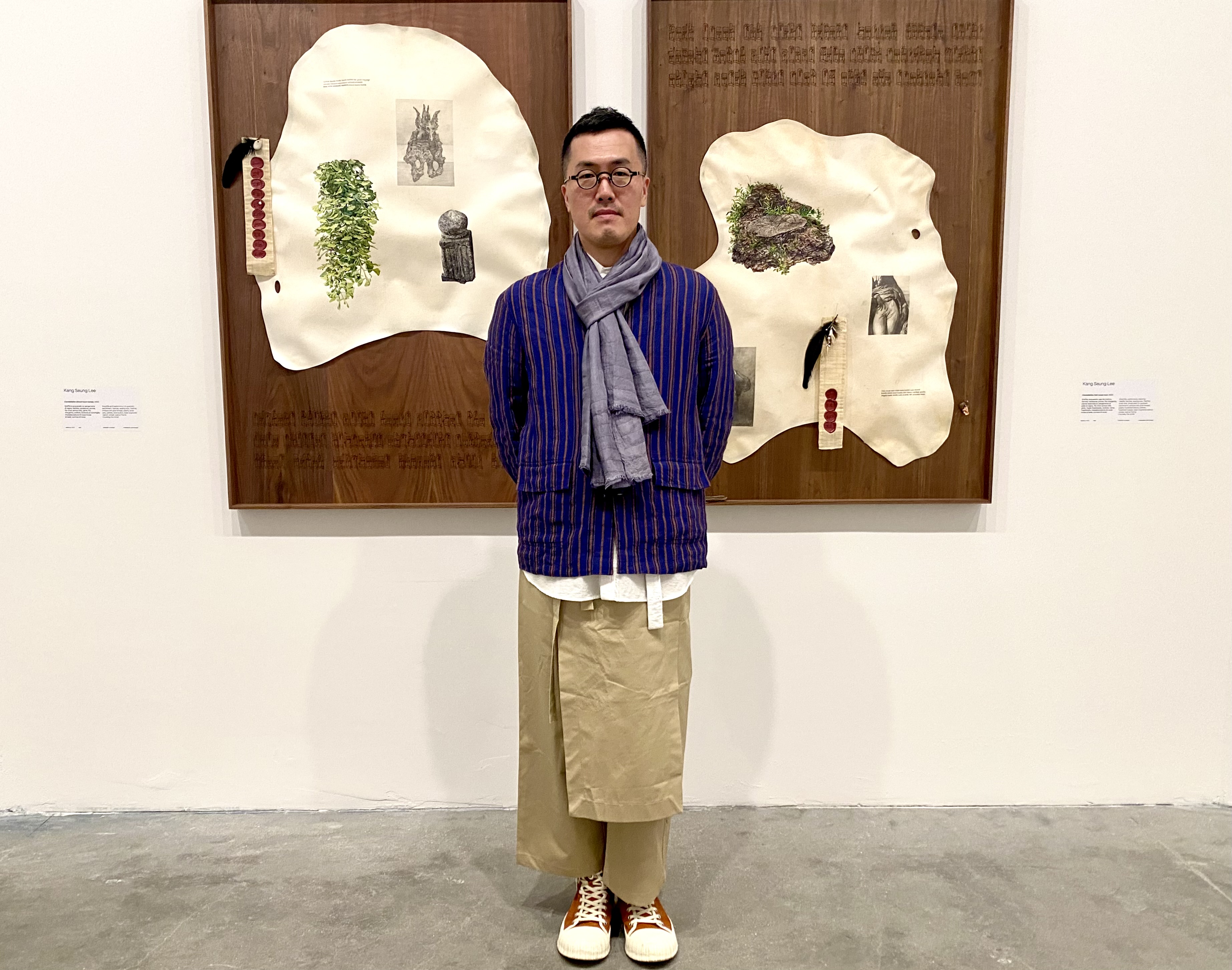
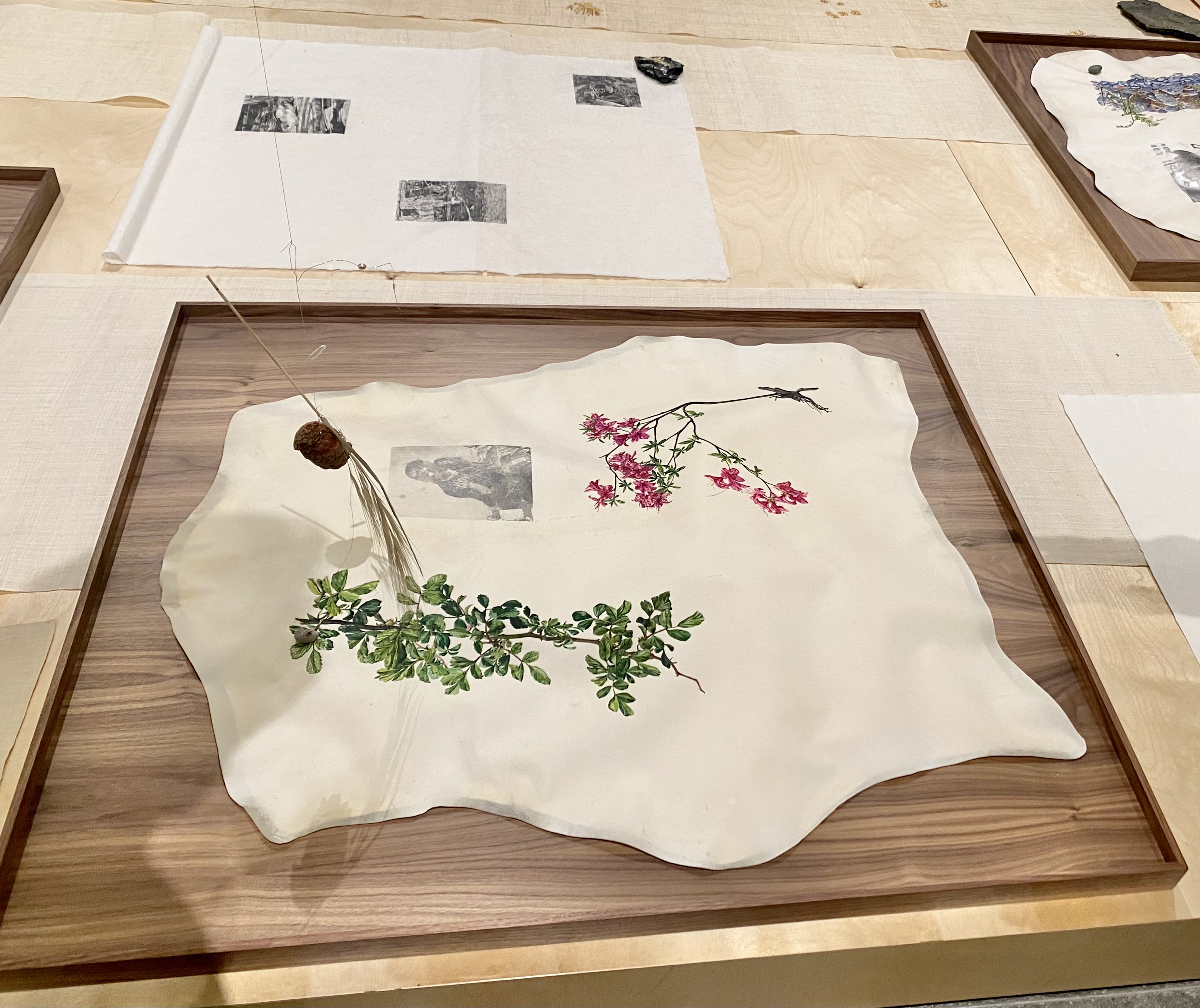
Kang Seung Lee engages in various artistic media including drawing, embroidery, installation, and appropriation of organic materials and objects. His work involves extensive research periods that are not just documentary but also integrate imagistic elements. Lee’s work is an installation based on the many narrative and iconographic possibilities of artistic figures who died due to AIDS-related complications. In the environment created by the artist, the spectator is able to reconfigure queer narratives in a transnational and transhistorical way.
Kang Seung Lee - Installation 


Kang Seung Lee


Drawings, embroideries made with 24-karat gold-plated lines, objects hung from the ceiling, and other elements installed on the walls allow viewers to move between narratives that pay homage to essential names of queer culture in an anti-monumental way rather than an encyclopaedic narrative.
Kang Seung Lee - Installation - detail


Gabrielle Goliath’s immersive installations and performances examine frameworks of inequality and oppression, highlighting how these conditions may be transformed. Personal Accounts - 2024 - is an ongoing transnational project initiated in 2014. It employs video and sound to create installations that address the global normativity of patriarchal violence. The project records the testimonies of black, brown, indigenous, femme, queer, non-binary, and trans individuals. Each account unveils everyday structures that preserve patriarchal, racializing and colonial orders. These stories deal with violence and trauma. But they also shed light on the “creative and fugitive ways in which survivors assert life and possibility”, which she reframes as strategies for survival and repair.
Gabrielle Goliath - Personal Accounts - 2024 


Ken Paradana and Ralph Rugoff - curator - 58th - La Biennale di Venezia - Arte

Superflex - Foreigners Please Don't Leave Us Alone With The Danes - poster -  2002


Louis Fratino is an artist whose paintings and drawings of the male body and domestic spaces capture the intimacy and tenderness found within everyday queer life. For Biennale Arte Fratino presents new paintings that explore the ways in which LGBTQ+ people are socialised to navigate the world as an “outsider”. This new body of work critiques the complexity of familial dynamics queer people face, beginning at childhood and continuing into adulthood. Drawing visual sources from the personal, Fratino juxtaposes the image of the family in contrast with visceral homoerotic imagery as a way to visually complicate the tensions between the two. 
Louis Fratino - Eggs, Dishes, Coreopsis - 2020 


Louis Fratino 


A pioneering figure in Korean and Argentinian art, working in sculpture, painting, and printmaking, Kim Yun Shin has travelled extensively during her life, an experience which is deeply reflected in her work. At the Biennale Arte, Kim presents a group of eight sculptures.  Conceptually, all of Kim’s works since the late 1970s possess the same title: Add Two Add One, Divide Two Divide One. Add and Divide are connected to Chinese philosophy’s Yin and Yang, which in turn represent multiple dichotomies and opposing concepts that are closely intertwined – two that are one, one that is two. Yin represents fragmentation, splitting, division, while Yang represents convergence, integration, addition. 
Kim Yun Shin - Add Two Add One, Divide Two -1979


Aref el Rayess, a sculptor, painter, designer, and beloved father, was a prolific and eclectic Arab Modernist whose oeuvre spans the colonial, decolonial, and so-called postcolonial periods.  
Aref El Rayess - Untitled -  Deserts Series - 1988


Philomé Obin, like his younger brother Sénèque - below - is one of the creators of the Cap-Haitien school of painting, named for the commune on the north coast of Haiti. With a wide range of themes and a recognisable and influential style of complex narrative compositions, Obin is a chronicler of social dynamics in the public space.
Philome Obin - Missionaire - 1951


Sénèque Obin – part of a family of artists that included his older brother Philomé - above - he was in his fifties when he began painting and joined Port-au-Prince’s Centre d’Art. Obin’s practice as a painter and as an art activist offers a rich point of view from which to understand the arts in the Americas in the mid-twentieth century. His work exposes the contradictions of the modernisation process, challenging labels like “self- taught”, “naive”, and “primitive” often applied to artists of colour, like himself, which have prejudicially obscured the understanding of their complex works. With its precise lines, bold colours, and multiple narratives, the painting alludes to commerce, extraction, and the transformation of natural resources, evoked both in the commodities offered in the market and by the surrounding mountainous landscape in the background.
Seneque Obin - L'Union Fait la Force - 1954


André Taniki is a shaman born in the region of the Upper Catrimani river, in the Brazilian Amazon. His artistic output is directly linked to his association with artist and photographer Claudia Andujar and anthropologist Bruce Albert. These drawings were done in the late 1970s, in conversation with Bruce Albert, when both were searching for ways to depict shamanic visions. Lushly coloured, the drawings combine abstractions and figurative schemata in structures that seem to represent the organisation of the cosmos from the point of view of the Yanomamis’ sense-universe. Thus, they may be observed as a kind of cartography of that which is visible only to the xapiri – the Yanomami shaman’s auxiliary spirits – and to the shamans themselves. Both the circumstances in which they came to being as well as the drawings themselves stand as relevant expressions of the possibilities of translation and communication between different systems of knowledge and relations.
Andre Taniki Yanomami - Untitled 2 - 1978-81


Abel Rodriguez and Aycoobo - Wilson Rodriguez - Terraza Vaja - 2022


Abel Rodríguez was born in the Putumayo Department of Colombia and trained as a botanical expert amongst the Nonuya, one of several Amazonian ethnic groups.  Sin título above - is from a series that focuses on the taxonomical exploration of different varieties of Amazonian trees, capturing their distinct characteristics such as colour, leaf shape, trunk texture, and overall plant architecture. These meticulous depictions correspond to the specimen’s real-life characteristics and serve not only as compelling artistic representations, but also as scientifically accurate portrayals of Amazonian biodiversity. 
Abel Rodriguez - Sin Titulo - 2023


Roberto Cicutto
President - La Biennale di Venezia - 2020-24


Aycoobo learned his craft empirically and through his father, renowned painter and plant expert Abel Rodríguez - see above - whose broad knowledge of the Amazonian landscape served as the foundations for elaborating on the worldview of the Nonuya people. The works presented in this exhibition address some of Aycoobo’s most pressing concerns: Calendario - below - is a drawing depicting a monthly calendar that associates the passage of time with the conditions of the Amazonian forests in each month of the year. It also represents the agricultural processes of the chagra - a part of the forest organically used for growing crops - as well as the underwater worlds and the centre of the earth. Together, all these works speak of what Aycoobo understands as a mandate: the transmission of knowledge and the creation of images that spring from a higher consciousness.
Aycoobo - Wilson Rodriguez - Naturaleza 2 - 2022


Aycoobo - Wilson Rodriguez -  Calendario - 2023


Pin It