Thursday, January 26, 2012

PARIS: Maison et Objet - Art - Design - Food - Restaurants - Fashion - People... and more


Paris - Design: Promemoria cocktail.  It has become a standing appointment to attend, on the Saturday of Maison et Objet weekend, the Promemoria cocktail party in their Paris store on the Rue de Bellechasse on the trendy Left Bank.  The Italian design company’s Ceo and Creative Director Romeo Sozzi and his son Davide hosted the event.


Promemoria – a detail. A detail of the sofa called Augusto. The full essential shape is softened by soft fabric upholstering.   The arms are made entirely in bronze and give a very modern look to the piece.  The soft and low back cushions give complete comfort. 
Note: the innovative mix of fabrics with the "cold" metal: velvet, linen and chenille.


Designer, Chrystal Ohoh works in the David Collins Studio in London.

 Promemoria's P.R. Chiara Del Vechio and Alain Lardet, founder of Designer's Days in Paris.


The fabric and furniture company C and C's Emanuele Castellini and his daughter Matilde.  


smoked salmon and rucola "rolls'.


designer and photographer Carina and Paul Robida.


Interior decorators relax in the courtyard, Rafael Gimenez and Emilye Morgan.

photograph courtesy Promemoria
 
Promemoria – a detail. A detail of the pouf Coccolone in special woven leather with smooth cognac leather sides and base in anthracite oak.


Maison Francaise's Gilles Dalliere and Chiara Del Vecchio.


 Journalist Paolo Bagnara, designer Ludwig Hartmann, architect Nicola Falcone and photo agent Luca Selvi.

photograph courtesy Promemoria 

Promemoria.   Poufs Coccolone and Coccolino. The colors are lively but never aggressive because Romeo Sozzi is a specialist in colors; he loves them, studies them and notates them in his inseparable notebook as he travels the world.  Two colors and two materials, fabric and leather which go well together also under different light reflection.


 Designer Eric Gizard and Marie Claire Maison's Jean Pascal Billaud.

 
 Founder of the Salone Satellite Marva Griffin-Wilshire, Promemoria's Romeo Sozzi and Sandra Arigoni.


Mini "mother of pearl" macaroons.


Pin It

Sunday, January 01, 2012

HAPPY 2012 - Fornsetti Calendar Plates


HAPPY 2012 – with - Fornasetti calendar plates. Piero Fornasetti’s collectable calendar plates were first created and produced in 1968. 
  Piero’s son, Barnaba has continued with this tradition since 1989, establishing a limited edition of 700 plates. The early editions of the calendar plates have entered the auction circuit selling at high prices. Other special New Years objects where produced and in the 1940s, the annuari or yearbooks were created in cooperation with Gio Ponti; hand-printed booklets in limited edition were given exclusively to friends and are of an unobtainable rareness. 

 Photograph courtesy Fornasetti

The Fornasetti mirrors. A collection of more than twenty mirrors with curved reflective surfaces, either concave or convex, which therefore have a deforming, enlarging or transformative effect are on show in the Fornasetti Milan flagship store. The mirrors are embellished or etched to various degrees, and are enclosed in beautifully decorated frames. These are magical objects because in their very complexity they induce a vivid sensation of ancient legends and fantastic stories, recalling aspects of a long-forgotten collective imagination. There was a well-known belief in northern European folklore that a convex mirror was “the witch’s eye” because, just like a huge eye, it could both observe and attract the attention of others. The strategy was to place at least one of these next to a door or window to prevent the entry of the evil eye and misfortune
Above: The Optical Mirror designed by Barnaba Fornasetti has four convex mirrors decreasing in size; the wooden frame is decorated with a black and white optical pattern.


Pin It

Monday, December 19, 2011

MERRY CHRISTMAS


Photo credit Gérard Blot courtesy Eni and Comune di Milano


Milano: Palazzo Marino – George de la Tour exhibition.  For the first time in Italy the "The Nativity" by Georges de la Tour (1593-1652) is on display (until January 8 2012) accompanied by one of the most famous masterpieces by the artist from Lorraine, "St. Joseph the Carpenter". The special event for the traditional Christmas exhibition at Palazzo Marino was organized by Eni with the collaboration of the Municipality of Milano and the Louvre and curated by Valeria Merlini and Daniela Storti.  There is little documentary evidence about the life of the artist, whose training and background remain shrouded in mystery. There is a continuing hypothesis that he may have travelled to Italy where he came into contact with the work of the great Caravaggio, to whom reference is always made in any critical analysis of de la Tour's work. The Nativity was added to the collection of the Louvre in 1926 after being attributed to La Tour by Hermann Voss, the great German art historian who, in 1915, had brought the artist back from the oblivion into which he had fallen.

 
Photo credit Gérard Blot courtesy Eni and Comune di Milano

George de la Tour: - The Nativity - a detail: The theme of the nocturnal adoration of the shepherds was one that spread out from Italy, starting in the early sixteenth century with Correggio's celebrated Adoration of the Shepherds, held in Dresden and commonly known as The Night. But, in the magical atmosphere of the work of Georges de La Tour, in the intimate and restrained domesticity of the scene, the Franco-Flemish stylistic tradition plays an important role. 


Photo credit Gérard Blot courtesy Eni and Comune di Milano
George de la Tour: St Joseph the Carpenter – a detail.  Also in the perhaps better known work, St Joseph the Carpenter, the warmth of the diffused light from the candle held by the young Jesus, who watches his putative father at work with admiration, is immersed in a night-time scene that was familiar to the Northern European tradition of the period. In the painting, the moving father-son relationship, also allows us to reflect on the iconographic character of the devotion to the Saint, the Son and the Cross, which is reflected in the work the Joseph is leaning over, in the manner of many of the religious texts of the period. Also from a technical perspective the work is perhaps the best example of a body of "candlelit" work by de la Tour. The light, which is hidden from the eyes of the observer by the hand of the Child and is spread across his face, which becomes the true source of the luminosity of a familiar and intimate scene, made transcendent. Visitors will be able to admire these two paintings against a dedicated backdrop, with carefully selected materials, that gives them the appropriate space to be fully appreciated. 

Photo credit Gérard Blot courtesy Eni and Comune di Milano

A donation has been made
AIRC
Associazione Italiana per la Ricerca
 sul Cancro

Pin It

Friday, December 16, 2011

Bright Colors for Gloomy Winter Days.


Photograph courtesy Lisa Corti

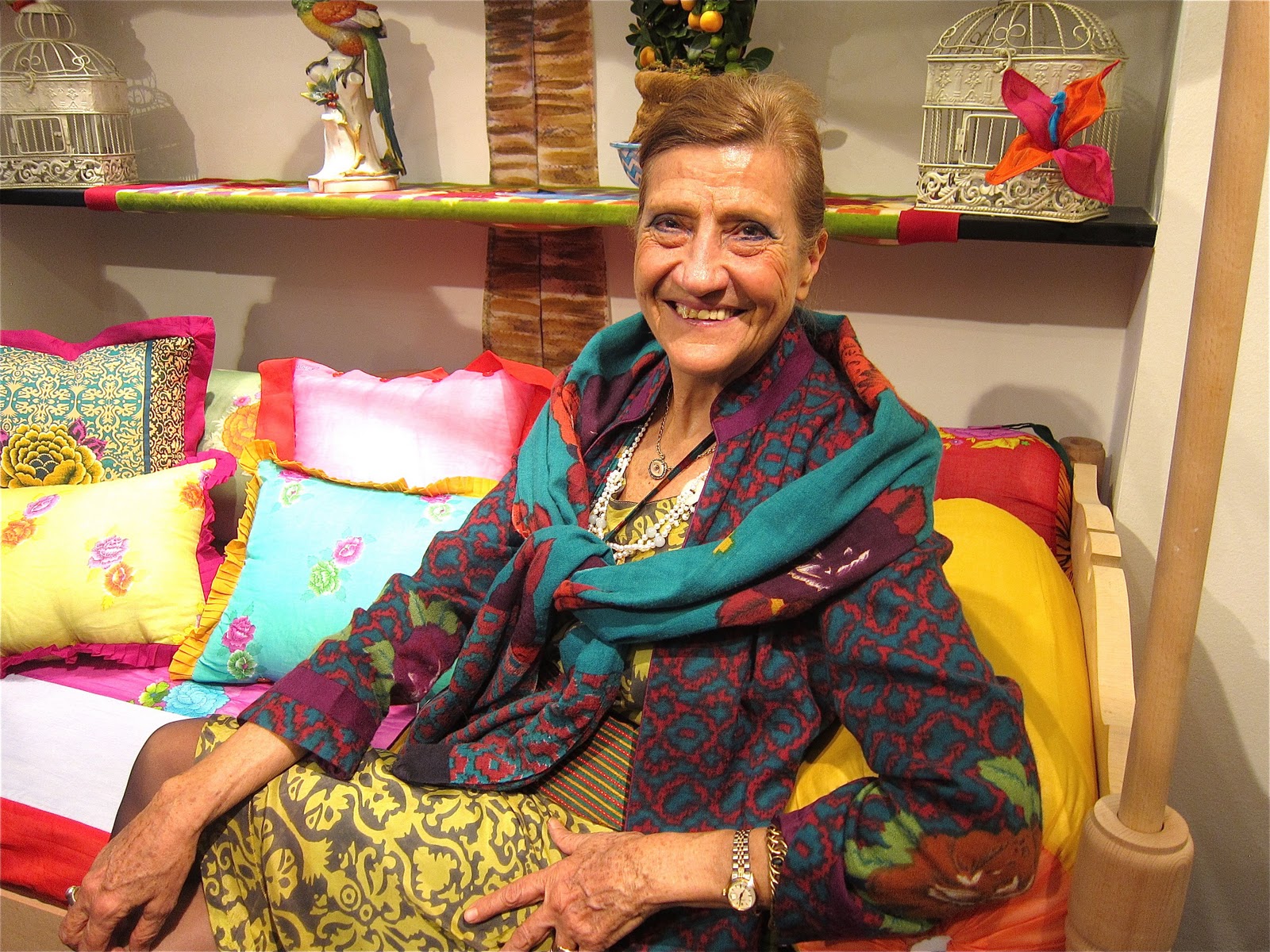
Milano: Lisa Corti - Bright colors for gloomy winter days.  Colorful cushions brighten up a room on the gloomiest of winter days and textile designer Lisa Corti is a master at color. The range of furnishings, clothes and articles made by Lisa Corti are well known for their characteristic weightlessness, transparency and wise use of colors and dyes. Mezzeri, quilts, mandala, blankets pillows, curtains, tapestries and tablecloths. The style is very oriental. The design is not only based on taste and elegance, but also on the care given to what is essential for a lifestyle that combines a touch of the Orient to the standards of Western living.


Lisa Corti.  Textile designer Lisa Corti wears her bright colorful clothes.   “Ask me about my work and I will tell you about my passion for color, a love that has roots in far away lands, in my childhood in Africa. Women dressed in color, only one color, moved into the light as if gliding. Mysterious angels in cobalt pink, yellow, green, violet. I have always carried them within me. It seems incredible, yet that cobalt, that pink in the sun are something I thrive on.”  She explains.


Lisa Corti.  Lisa Corti’s sketchbook sits on a table in her home.  Inspiration comes from her various trips to India where she has carried out an in-depth search on the wide range of fabrics and patterns in various areas of the country and creatively transforming her designs, materials and colors in an infinite number of objects and articles intended as house decorations and furnishings


Lisa Corti.  Roses from the garden are also an inspiration for her designs.


Lisa Corti.  Color swatches hang over a painted chest in her design studio.  "When I discovered India. I found the essence once again in the sweet organza, the impalpable glossy colored air and the fragment of a cloud to be touched and used. Pure color that comes to life as substance, it is weightless and runs, cheerful and gentle, stopping at a central point. It winks and cannot be ignored. These are my tapestries.” 

Lisa talks about her inspiration.


 Photograph courtesy Lisa Corti

 Lisa Corti.  Just six of the many colorful patterns Lisa Corti has designed. For the designer, taste and beauty are not only aesthetic objectives, they are also essentials that fill up her daily life, as well as her furnishings and clothing. Geometry is a constant, as are the elements of nature, the intense colors, the transparencies and weightlessness of the fabrics. Lisa invents things that she enjoys; she does not chase after fashion but goes for the sense of color, light and shapes, in the constant search for symmetry between ancient and contemporary Western cultures.


Pin It

Tuesday, December 06, 2011

Follina: Local color - people seen at the Christmas Market


Follina: Local color - people seen at the Christmas Market.  Tucked amongst the Prosecco vineyards the picturesque village of Follina, just north west of Venice, is famous for it’s Cistercian Abbey built in 1150. Not to be missed, is a visit, not only to the Abbazia di Santa Maria di Follina itself, an impressive fusion of Romanesque and Gothic styles but also to its cloisters with elegant columns. For the past seven years every first weekend of December a Christmas market is held in and around the main square, called Colori d’Inverno or winter colors the market opens the festive season.
Above: Better known as La Contessa, local watercolor artist, Francesca Brandolini d’Adda stands in the main Follina square in front of her enlarged watercolor of the Follina square as it used to be in the mid 19th century.


Follina: Local color - people seen at the Christmas Market.  Marco Milillo is a private investigator in Conegliano and also a landscape and fashion photographer.  Melillo presented his infrared, black and white photos of vineyards. 


Follina: Local color - people seen at the Christmas Market. Gigi Miracoli with his partners produces biological wine in Venice, Yes Venice, the winery is called La Laguna nel Bicchiere or The Lagoon in a Glass and the wines are derived from an unusual bower-fruit  garden at the Murano Cemetery, and from a vineyard of the 1960s in Giudecca's Cipriani zone. He is also a street artist; he blows bubbles, eats fire and walks on fire, just to name a few of the crazy things he does to amuse.


Follina: Local color - people seen at the Christmas Market.  Mari is the youngest of the hoteliers Zanon siblings; she runs the La Volta luxury gift shop, which is part of the elegant Relais & Chateaux Villa Abbazia Hotel complex.  La Volta looks onto the main square and in the store you can find elegant gifts, ranging from silver, hand blown glass, candles, pot-pourri, perfumes and naturally at this time of the year Christmas ornaments.


Follina: Local color - people seen at the Christmas Market.  The indefatigable Maria Gabriella Sorbara Sammartini owns and runs two Magamaison stores, as well as her home, her husband the very talented wood worker, Vettor Sammartini, two dachshunds, Molly and Krauti, and last but not least Berta the cat.  And, she still has the energy to visit clients and run Magamaison the interior decorating showroom/store/laboratory, which sells custom made items for the home. New for Christmas these amusing embroidered linen sacks, which can hold towel sets, Foutas or anything that strikes your fancy. 


Follina: Local color - people seen at the Christmas Market.  Local chocolatier Oriana Chantal Balliana has a soft spot for heart shaped chocolates; in fact her company is called Q-ori & Chocolato, Q-ori being a play on the word hearts in Italian.   Year round, with her gourmet chocolates she tours the local specialized fairs and recently she has gone to India for a wedding where she made flower and… wait for it…. Heart shaped chocolates, non stop for five days running.


Follina: Local color - people seen at the Christmas Market.  In the neighboring village of Miane, entrepreneur Ornella Tonet founded the luxury small knitwear workshop Carella with her late sister Carla.  Later the ToneT collection (in the photograph above) was added to the company, it focuses on a total look with strong stylistic contents. The quality Italian knitwear company sells in major markets around the world as well as producing samples and knitwear for third parties.


Follina: Local color - people seen at the Christmas Market.  Self taught florist Francesca Simonetti's shop, L’Idea in Follina is right by the Cistercian abbey, so it is no wonder that she specializes in flower arrangements for churches and weddings.   She conceived and designed the decorations for the Christmas market.  Her style could be described as modern country.
L’Idea: Via Padre Anacleto Milani 2 – Follina (Treviso) – tel: +390438970033


Follina: Local color - the Christmas Market.  The obelisk decorations conceived and designed by Francesca Simonetti of L’Idea flower shop in Follina where scattered around the streets and added a festive tone to the Christmas market.  “I am inspired by what is available,” she explained.

Pin It